Compare guide
Hiring a solo videographer vs. a production company for corporate video
Hire a solo videographer when the job is simple, the stakes are modest and one skilled person can do all of it: a single interview, a small event, a quick recap. Hire a production company when you need several skills at once, when the shoot can’t be repeated, or when your procurement team needs insurance and a company to contract with. The right question isn’t which is cheaper. It’s what happens if the one person gets sick, the audio fails or the scope grows.
We’re a production company, so weigh that accordingly. Our honest view is that plenty of corporate jobs don’t need a big crew; we shoot two-camera interviews solo ourselves, and add a second operator when a client requires it.
The two options, side by side
| Solo videographer | Production company | |
|---|---|---|
| Who’s on set | One person | A crew sized to the job |
| Who edits | Usually the same person | An editor, plus motion graphics when needed |
| Price | Often lower for simple jobs | Higher, with more included |
| Backup if someone’s sick | Depends on their network | Usually built in |
| Multi-room events | Limited to one place at a time | Multiple operators |
| Insurance and paperwork | Varies, so ask | Usually in place, but still ask |
| Point of contact | The person filming | A producer or the owner |
| Best for | Simple, repeatable jobs | Complex, public or one-time shoots |
When a solo videographer is the right call
The shoot is simple. One interview in a quiet room, a short testimonial, or a small event with one speaker.
You could reshoot if something went wrong. If the CEO can come back on Tuesday, the risk is low.
You’ve worked with them before. Great solo shooters exist, and a trusted one is worth keeping.
The budget is limited and the need is clear. One good person beats a stretched crew.
When you need a production company
It only happens once. A conference keynote, a retirement speech or a CEO who has 20 minutes this quarter can’t be repeated. Backup equipment and a second person are cheap insurance.
Several things happen at the same time. A multi-track conference needs someone in each room, and a live stream needs someone switching, someone watching the audio and someone at the camera.
The job needs several skills. Writing, directing, lighting, sound, editing and animation are different crafts. One person may do some of them well, but rarely all of them.
Your company has procurement rules. Larger organizations often want a certificate of insurance, a vendor form and a contract. The Small Business Administration’s overview of business insurance explains the basic types. Ascari Digital is insured and holds a small business certification.
It’s a long project. A 9-module course or a 100+ video library needs a system to keep things on track, along with people who can step in. We’ve done both.
Where the price gap comes from
A production company has more people and overhead, and that shows in the price. But compare like with like. A solo day rate may not include editing, music licensing, revisions or travel. The total for the finished video can be closer than the headline suggests.
Rates also reflect real costs. The Bureau of Labor Statistics puts the national median at $74,990 for camera operators and $75,420 for film and video editors as of May 2025. That’s before equipment, insurance or the cost of running a business. Very cheap quotes usually mean something’s been left out.
With us, a single-camera production day starts at $1,500, a highlight edit at $1,000 and a hero video at $4,500. Our pricing page lists everything, and every quote is one fixed price.
Questions to ask either one
- Can I see work like mine, made by the person who’d do mine? Great reels sometimes come from other people’s crews.
- Who will actually be on set, and who edits? Get names if it matters.
- What happens if someone gets sick? There should be a clear answer.
- Do you have backup gear? Especially audio, and especially for one-time shoots.
- What’s included in the price, and what would make it go up?
- How many revision rounds are included?
- Are you insured? Ask for a certificate if your company requires one.
- Who owns the finished video and the raw footage? Under US copyright rules, paying a contractor doesn’t automatically transfer ownership, so put it in writing.
Is there a middle ground?
Yes, and it’s often the best option: a small company that sizes the crew to the job. You get a single point of contact, and the work scales up only when it has to.
That’s how we work. Brandon scopes every project himself and stays your contact through delivery. A simple interview might be one person. A multi-day conference gets more. Either way you talk to the owner, not an account manager.
Whichever way you go, the safest test is simple. Imagine the worst realistic thing that could go wrong on the day, then ask the person you’re hiring what they’d do about it. A good videographer and a good production company will both have an answer.
If you want a straight opinion on your project, tell us what it is. If it’s a job for a solo shooter, we’ll say so. See our corporate video production page for how we work.
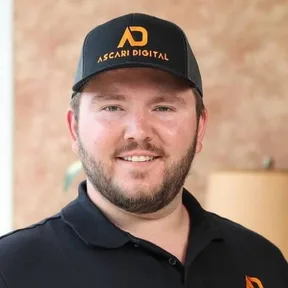
Brandon Ascari
Founder of Ascari Digital, a video production company in Cherry Hill, New Jersey. Brandon holds an MFA, has more than ten years in production, and taught video production at Seton Hall University. His crew produces for Google, Sony and Informa Connect and runs its own YouTube channels.